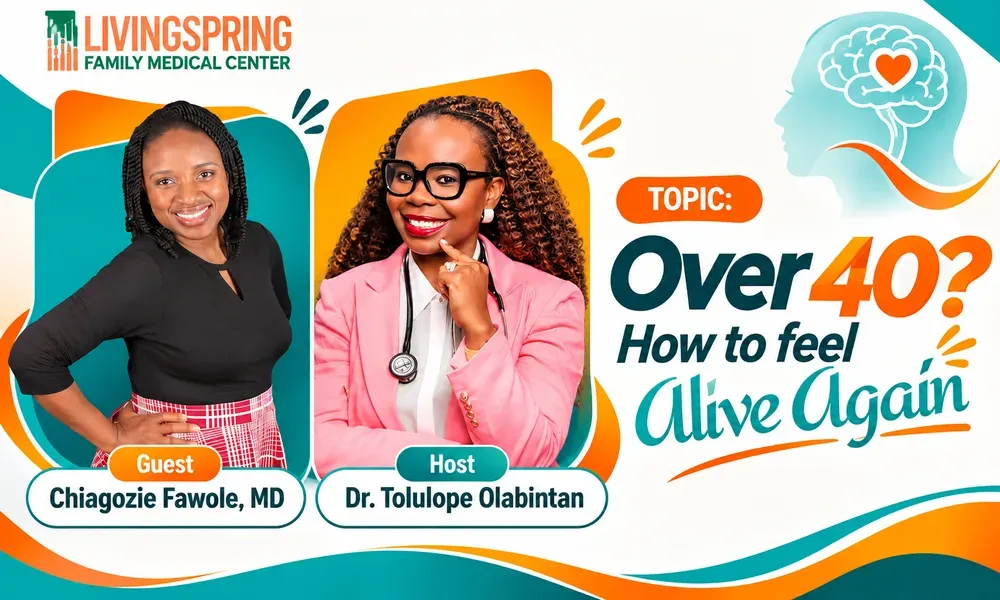
Over 40? How to Feel Alive Again
Turning 40 should not mean saying goodbye to your comfort, confidence, intimacy or quality of life.
Let's have an honest conversation, ladies.
Have you noticed that your body doesn't seem to respond the way it used to? Perhaps your sleep has changed. Your energy is different. Your mood seems unpredictable. Intimacy isn't as comfortable as it once was. Maybe you have started experiencing occasional urine leakage when you laugh, cough, sneeze or exercise.
And you're wondering, Is this just what happens when a woman gets older?
Well, I have some good news for you: you do not have to simply accept every uncomfortable change as your new normal.
During one of our Tete-a-Tete conversations, I sat down with the wonderful Dr. Chiagozie Fawole, an anaesthesiologist, founder and lead physician at Brighton Park Regenerative Medicine and Longevity in Syracuse, New York, to discuss a subject that deserves far more attention: how women can feel alive again after 40.
Dr. Chiagozie works with women navigating perimenopause and other changes that affect their intimate health, hormones and overall quality of life. And trust me, we had a conversation!
We discussed everything from vaginal dryness and urinary incontinence to hormonal changes, treatment options, lifestyle adjustments and why women must learn to advocate for their health.
One thing became very clear: you do not have to suffer in silence.
[WATCH THE FULL TETE-A-TETE REPLAY HERE – INSERT VIDEO LINK]
1. Your Body May Be Changing Before You Actually Reach Menopause
First, let's clear up something.
Menopause is not necessarily something that suddenly happens when you turn 50. In fact, the transition towards menopause can begin several years before your periods eventually stop.
This transition is called perimenopause.
Dr. Chiagozie explained that hormonal changes can begin 10 to 15 years before menopause for some women. During this period, hormones such as oestrogen and progesterone can fluctuate significantly.
For some women, the changes are gradual. For others, the fluctuations can be quite dramatic.
And because hormones influence several systems in the body, the symptoms can show up in different ways.
You may experience:
-
Changes in your menstrual cycle.
-
Mood swings or increased anxiety.
-
Difficulty sleeping.
-
Hot flashes and night sweats.
-
Vaginal dryness.
-
Reduced sexual desire or changes in sexual comfort.
-
Joint aches and pains.
-
Changes in energy levels.
-
Urinary symptoms, including worsening leakage.
Here's something important: these symptoms do not necessarily appear together, and they are not exclusive to perimenopause. Other health conditions can cause similar experiences.
However, when several changes begin to occur around the same period, it may be worth asking your healthcare provider whether hormonal changes could be contributing.
Sometimes, we treat each symptom separately without recognising that they may be connected.
What if your poor sleep, hot flashes, joint discomfort and vaginal dryness are not four unrelated problems?
What if they are different branches of the same tree?
That is a conversation worth having with your doctor.
2. Intimate Health Is Part of Your Overall Health
Now, let's talk about something many women find uncomfortable discussing.
Vaginal dryness. Reduced lubrication. Discomfort during intimacy. Changes in sexual function.
Why don't we talk about these things more openly?
Dr. Chiagozie explained that declining and fluctuating hormone levels during perimenopause and menopause can affect vaginal and vulvar tissues.
Oestrogen plays an important role in maintaining the health, elasticity, thickness and lubrication of vaginal tissues. As hormone levels change, some women experience what is known as genitourinary syndrome of menopause (GSM).
This can involve:
-
Vaginal dryness.
-
Burning or irritation.
-
Pain or discomfort during sexual activity.
-
Reduced natural lubrication.
-
Urinary urgency or discomfort.
-
Recurrent urinary tract infections.
And it is not just about intimacy.
These changes can affect a woman's confidence, relationships, daily comfort and overall quality of life.
Imagine looking forward to a family holiday but constantly worrying about discomfort. Or avoiding intimacy because you anticipate pain. Or feeling disconnected from your partner because something has changed physically, but you don't know how to explain it.
These are real concerns. They deserve attention, compassion and appropriate medical care.
Your intimate health is not a trivial matter. It is part of your health.
3. Urine Leakage Is Not Something You Must Simply Endure
Have you ever laughed so hard that you leaked urine?
Or perhaps you coughed, sneezed, jumped or lifted something and suddenly felt a little leakage.
Some women begin to experience this after childbirth. Others notice it becoming worse as they approach menopause.
One common explanation is stress urinary incontinence.
Dr. Chiagozie used a simple illustration during our conversation to explain what happens.
Think of the bladder as a container holding urine. The urethra is the tube through which urine leaves the body. Muscles and supportive tissues around the bladder and urethra help control the release of urine.
When these supporting structures become weakened or less effective, activities that increase pressure inside the abdomen, such as coughing, sneezing, laughing or exercising, can cause urine to leak.
Pregnancy and childbirth can affect the pelvic floor muscles and supporting tissues. Hormonal changes associated with perimenopause and menopause may also contribute to urinary symptoms.
This is why some women notice that symptoms they previously managed become more troublesome over time.
But please hear this: urine leakage is common, but that does not mean you should ignore it or assume nothing can be done.
Depending on the cause, treatment may include pelvic floor muscle training, lifestyle changes, weight management, medication, vaginal oestrogen for appropriate patients, or other specialist interventions.
If you are experiencing leakage, speak with your healthcare provider. You deserve to understand what is happening and what options are available.
4. Why Your Parents' Experience May Not Be Your Experience
One question that came up during our conversation was particularly interesting.
Some women wonder why their mothers or grandmothers appeared to go through menopause without experiencing the same challenges.
Does that mean something is wrong with them?
Not necessarily.
Dr. Chiagozie explained that women do not all experience perimenopause and menopause in the same way. Genetics, individual hormonal patterns, medical history, lifestyle and environmental factors can all influence the experience.
She also made a point about the world we live in today.
Think about it.
Many women are juggling demanding careers, raising children, caring for ageing parents, managing households, building businesses and carrying responsibilities that leave very little room for rest.
The mental load can be enormous.
Our mothers and grandmothers had their own challenges, certainly. But the social and work environments in which they lived were not identical to ours.
Today, a woman may finish a full workday, attend to family responsibilities, answer dozens of messages, manage multiple deadlines and still be expected to show up tomorrow as though nothing happened.
Now add hormonal fluctuations, poor sleep and physical discomfort to that picture.
It is understandable that some women may find this season particularly challenging.
So, please, extend grace to yourself.
Needing help does not make you weak. Seeking treatment does not mean you are failing at ageing. And comparing your experience with another woman's experience may prevent you from getting the care you need.
Your body, your history and your circumstances are your own.
5. What Can You Do to Feel Better?
Now, this is where things get practical.
The encouraging thing about this conversation was that we did not stop at identifying the problems. We explored options.
Dr. Chiagozie emphasised that the first place to start is with the things within your control.
Start with your lifestyle
Before exploring procedures or medication, take an honest look at your everyday habits.
Prioritise sleep.
Your body needs adequate rest. Create a bedtime routine, reduce distractions and give yourself an opportunity to sleep well.
Eat well.
Your nutrition matters. A balanced diet supports your overall health and can form part of a broader approach to managing this season.
Move your body.
Regular physical activity supports cardiovascular health, metabolic health, mood and general well-being. Choose activities that are appropriate for your fitness level and health status.
Consider weight management where appropriate.
Dr. Chiagozie noted that weight loss can improve urinary leakage symptoms in some women who are overweight or living with obesity. Even modest weight reduction may make a difference for some individuals.
These lifestyle measures are not a cure for every perimenopausal symptom, but they are important foundations for better health.
Understand the treatment options available
During our conversation, Dr. Chiagozie discussed several interventions offered at her practice.
It is important to understand that these treatments are not interchangeable, are not suitable for everyone and have different levels of supporting evidence. A proper assessment is necessary before deciding whether any of them is appropriate.
1. Vaginal oestrogen
For some women experiencing vaginal dryness and other symptoms associated with genitourinary syndrome of menopause, low-dose vaginal oestrogen may be an option.
It can help improve vaginal tissue health, lubrication and certain urinary symptoms.
Unlike systemic hormone therapy, vaginal oestrogen is generally designed to act locally. However, suitability depends on an individual's medical history, and women with a history of certain cancers or other medical concerns should discuss the risks and benefits with their healthcare team.
2. Pelvic floor muscle training
The pelvic floor muscles support the bladder and other pelvic organs and play an important role in urinary control.
Pelvic floor muscle training, often called Kegel exercises, can help strengthen these muscles and improve certain forms of urinary incontinence.
A pelvic health physiotherapist can help you identify the correct muscles and develop an appropriate programme.
3. The O-Shot
Dr. Chiagozie also discussed a procedure known as the O-Shot.
This involves using platelet-rich plasma (PRP), prepared from a patient's own blood, and injecting it into targeted genital tissues.
The procedure is marketed for certain sexual and urinary concerns, with the aim of promoting tissue regeneration.
However, evidence supporting its effectiveness for these indications remains limited, and it is not an established first-line treatment for menopause-related vaginal or urinary symptoms. Women considering it should discuss the evidence, potential risks, alternatives and costs with an appropriately qualified clinician.
4. Emsella
Another treatment discussed was Emsella, a device that uses electromagnetic stimulation to induce pelvic floor muscle contractions while the patient sits on a specialised chair.
It is marketed as a non-invasive option for pelvic floor strengthening and urinary incontinence.
It may be considered in selected patients, but it is not suitable for everyone. For example, people with certain implanted electronic devices, including some pacemakers, may not be candidates.
A proper medical assessment is essential before treatment.
5. Hormone therapy
Hormonal changes can contribute to several symptoms experienced during perimenopause and menopause.
For some women, menopausal hormone therapy may help manage troublesome symptoms. However, the decision to use it must be individualised.
Your age, symptoms, medical history, personal risk factors and treatment goals all matter.
Please do not start hormones simply because someone online recommends them. Have a proper conversation with a qualified healthcare professional.
The goal is not to pursue every available treatment. It is to identify what is causing your symptoms and choose an appropriate solution.
6. Small Improvements Can Give You Back Parts of Your Life
One of the most encouraging parts of Dr. Chiagozie's contribution was hearing about the experiences of women who sought help for urinary symptoms.
She shared the story of a woman who had a 30-minute drive to work but regularly had to stop at a petrol station along the way because she could not comfortably hold her urine until she arrived.
She also described a woman who was a major support system for her family, caring for relatives and carrying significant responsibilities. Yet, urinary leakage was affecting her confidence and making everyday life more difficult.
Imagine being able to manage so many responsibilities but feeling that one aspect of your body is outside your control.
For some people, the ability to travel without worrying about finding a toilet, exercise without fear of leakage or simply laugh freely can make a meaningful difference.
These may sound like small things to someone who has never experienced the problem.
But when something affects your daily routine, confidence and freedom, finding appropriate help can be life-changing.
And that is what healthcare should be about: improving quality of life, not merely treating numbers on a medical chart.
7. How Do You Know If You Are Experiencing Perimenopause?
There is no single symptom that confirms perimenopause.
However, changes in your menstrual cycle can be an early indication.
For example, a woman who has always had a predictable 28-day cycle may begin to notice that her periods are coming closer together, becoming irregular or changing in flow.
Other symptoms may include:
-
Hot flashes.
-
Night sweats.
-
Changes in mood.
-
Increased anxiety.
-
Sleep disturbances.
-
Vaginal dryness.
-
Reduced sexual comfort.
-
Joint aches.
-
Changes in urinary symptoms.
Some women experience several symptoms, while others experience very few.
If you are noticing changes, keep a record of your symptoms, menstrual cycle and how they are affecting your daily life.
This information can help your healthcare provider assess what may be happening.
Also, remember that not every symptom in a woman over 40 is caused by perimenopause. Thyroid conditions, anaemia, medication effects and other health concerns can produce similar symptoms.
That is another reason not to self-diagnose.
8. Advocate for Yourself: Ask Your Doctor the Right Questions
This is one of my favourite takeaways from our conversation.
Sometimes, we visit the doctor, mention a symptom, receive treatment and leave.
Then another symptom appears. We return, mention that one and receive another treatment.
Before long, we are managing several different concerns without asking whether there may be a connection between them.
Dr. Chiagozie encouraged women to raise the possibility that their symptoms could be related to perimenopause.
You can start with a simple question:
"I've noticed that I'm experiencing several changes around the same time. Could these symptoms be related to perimenopause?"
You can also ask:
-
Could my sleep problems, hot flashes and mood changes be connected?
-
Could hormonal changes be contributing to my vaginal dryness?
-
Why am I experiencing urine leakage?
-
Would a pelvic floor assessment be helpful?
-
Are there treatment options that may improve my symptoms?
-
Would hormone therapy be appropriate for me?
-
Are there other conditions we should rule out?
And here is another tip I often give patients: tell your doctor what the symptoms are costing you.
Don't just say, "I leak urine sometimes."
Explain that you have stopped exercising because you are embarrassed. Tell them that you avoid travelling with your family because you are constantly looking for a toilet. Explain that intimacy has become uncomfortable and is affecting your relationship.
These details matter.
Healthcare is not only about identifying a diagnosis. It is also about understanding how a condition affects your life.
You are allowed to ask questions. You are allowed to seek clarification. You are allowed to ask about alternatives.
Please advocate for yourself.
9. Your 40s, 50s and Beyond Can Still Be Full of Abundant Life
As we wrapped up the conversation, Dr. Chiagozie shared one final message that I absolutely loved: raise your expectations.
Do not assume that because you are getting older, discomfort must become your permanent companion.
Do not automatically accept that you must stop travelling, exercising, enjoying intimacy or participating in activities you love.
And do not allow embarrassment to prevent you from seeking help.
As women, we often become so accustomed to taking care of everyone else that we forget to pay attention to ourselves.
We care for our children. We support our partners. We show up for our parents, friends, colleagues and communities.
But who is looking after you?
This season is an invitation to pay attention to your body, understand its changes and make informed decisions about your health.
CLICK HERE TO WATCH THE FULL REPLAY – https://www.youtube.com/live/0mdkw_KgDz0?si=zgWKVELGz3o5eG9-
This article is for general health education and does not constitute individual medical advice. Symptoms associated with perimenopause and menopause can have other causes. Treatment decisions, including the use of hormones or procedures, should be made with a qualified healthcare professional following an individual assessment.